The First 50 Years: 1896-1945
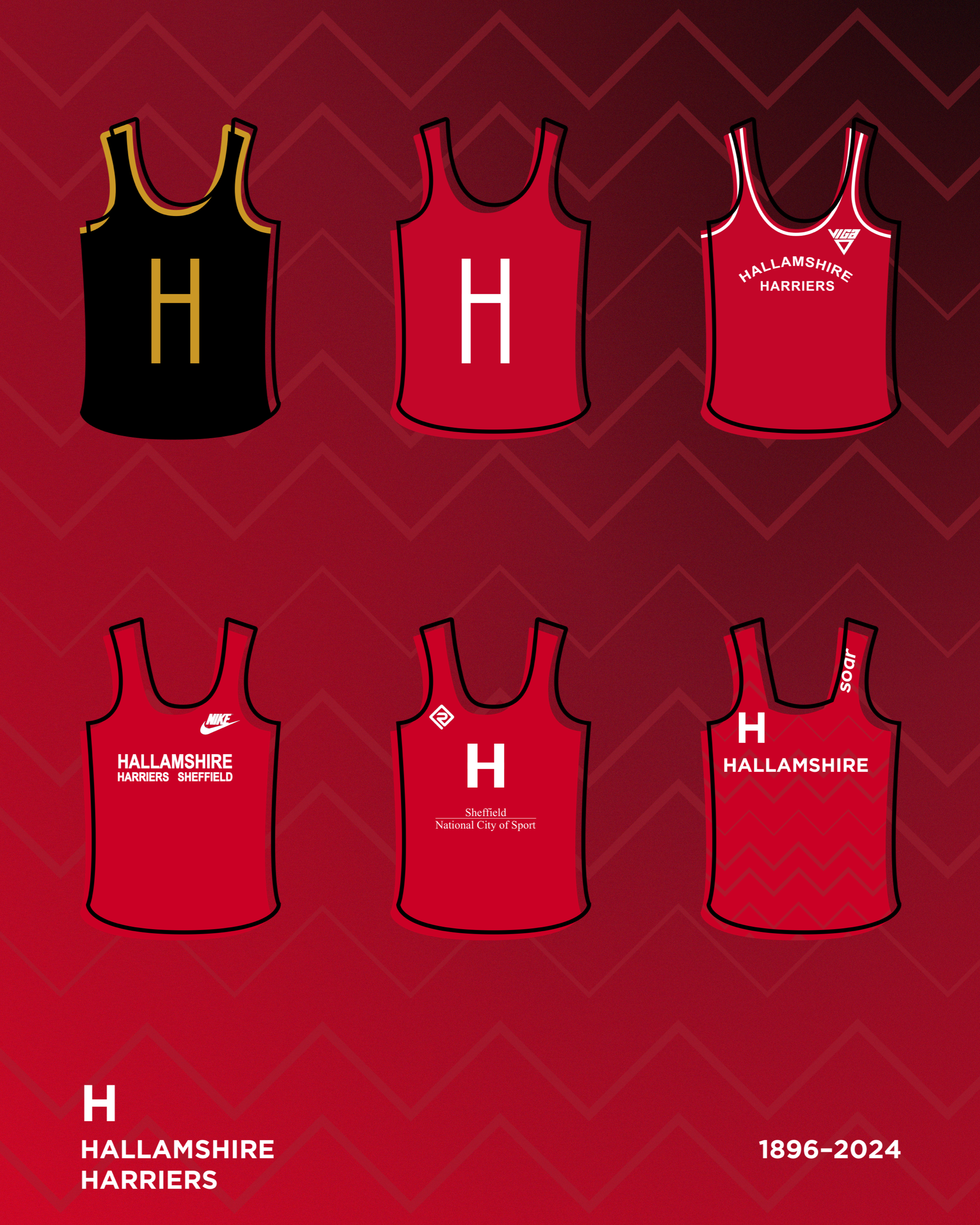
The club was formed August 31st 1896. It was put together by former members of Sheffield YMCA. Harriers together with “runners and supporters of cross-country and flat running.” The original team colours were black with gold facings. The now familiar red vest with a white “H” was not introduced until about 1911. Membership fees were set at 4/- for adults (20p) and 2/6 for juniors (12½p).
The club quickly established itself as force on the Yorkshire Cross Country scene, achieving second place in the Junior competitions for both of the first two years, and providing the overall winner with F. Clarke. This was followed by a second place in the Senior competition in 1899.
The early 1900’s saw the beginning of the club’s rise to fame. 1904 brought the Yorkshire Senior XC Championship to Sheffield for the first time, an achievement which was to be repeated every year from 1907-1914 and nine of the twelve years from 1923-1934. The National XC Team Championships were added for the years 1908, 1910-1912, 1927. In 1909, 1913, 1927 and 1929 HH athletes also took the individual honours: Joe Murphy (1909), Ernest Glover (1913) and Ernest Harper (1927, 1929).
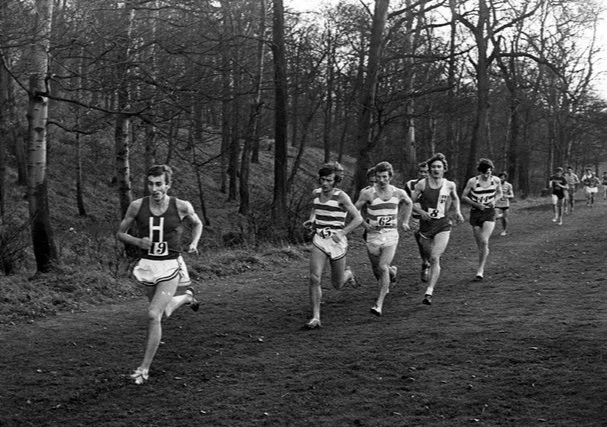
These golden years also brought international success for a number of individuals. HHS provided six Olympic Representatives during this period. James Murphy was 10th in the 5 mile at the London 1908 Olympics. Harold Wilson won Silver for Great Britain in 1500m at the 1908 London Olympics. He was also a member of the 3×3 mile team. He is pictured below (2nd left).
Harold is enshrined in history as the first man to break the 4 minute barrier for 1500, which he did running 3:59.9 in London, 30th May 1908. Ernest Glover was chosen for 5km, 10km, and XC at the 1912 Stockholm Olympics, winning a team Bronze in the latter. Although qualifying for the finals of both 5km and 10k he lined up for neither. William Cottrill won a team bronze at the 1912 Stockholm for his part in the 3x3000m: he also competed in the 1500m at the same Olympiad. Joe Williams finished 7th in the 10km at the 1924 Paris Olympics. Joe went on to become a Club coach in 1940, and the Club President from 1968-1975. Norman Biddulph finished 10th in the 3000m Steeplechase at the 1928 Amsterdam Olympics.
The above culminated with probably the best known pre war Harrier – Ernest Harper. He had represented GB at the 1924 Paris Olympics, finishing fifth in the 10km and fourth in the 10km Cross Country race. This was at a time when distance running was dominated by the Finns. Indeed, the 10km track was won by Ville Ritola and the 10km XC by Paavo Nurmi. In 1928, he again represented GB at the Amsterdam Olympics, finishing 22nd in the Marathon. An illustrious career was crowned with a Silver medal in the Marathon at the 1936 Berlin Olympics Marathon, behind the famous Korean Sohn Kee-chung, running under the occupying country of Japan’s flag.
The 2nd WW put paid to many activities and competitions, including serious athletics.
1945 to 2000
Post WWII, fortunes switched to HH’s great local rivals, Sheffield United Harriers, who enjoyed success through athletes such as Roland Hardy, the double Olympian who was part of SUH’s great road walking successes in the 1950s, and Ken Wood, who finished 9th in the 1500m at the 1956 Melbourne Olympics. SUH also took on the mantle of bringing the National Team XC Championships back to Sheffield, in 1956 and 1959. This was to be the last Team victory at National XC level for a Sheffield club, although the balance was redressed a little for HH when Trevor Wright won the individual Championship in 1970.
Nevertheless, Olympic success continued for the City, albeit not through HH, with the prolific husband and wife team John and Sheila Sherwood. Sheila performed in the Long Jump at three Olympics: 1964 Tokyo, 1968 Mexico, 1972 Munich; winning a silver medal in Mexico. John competed in the 1968 and 1972 Olympics in the 400m hurdles, winning bronze in Mexico. He was also a member of the 4x400m Relay team.
The Olympic dream then reverted back to HH with arguably the most successful Olympic record by any GB track athlete, when Sebastian Coe achieved Gold (1500m) and Silver (800m) in consecutive Olympics at Moscow 1980 and Los Angeles (1984). Seb cannot be rivalled as Hallamshire’s most outstanding athlete, famously breaking world records for 800m, 1 mile and 1500m in a phenomenal spell of just 41 days in 1979. When he added the 1000m world record the following year, he held 4 world records simultaneously. In all, Seb broke EIGHT world records to add to his four Olympic medals. His 800m world record time of 1:41.73 back in 1981 stood for 16 years, and has still only been bettered by two men, Wilson Kipketer (1:41.11) and David Rudisha (1:40.91).
Yvonne Hanson-Nortey gave us our last 20th Century Olympian, performing at the Seoul Olympics 1988 in the Shot Putt.
Despite missing out on the Olympics, Trevor Wright was an outstanding distance runner for the club in the early 1970s. He won Bronze (1970) and Silver (1971) International Cross Country Competitions and Marathon Silver in the 1971 European Championships at Helsinki. Trevor’s mantle was taken up some 20 years later by another exceptional distance runner, Carl Thackery. Carl still holds the British records for 15k and 20k, plus the 1 hour record of 20,855m. These were all achieved in a single race at La Fleche in 1990. He also won individual Bronze, together with Team Silver, at the World Half Marathon Championships I n1993.
The second 50 years also brought about change in club location. By 1954, the club was operating out of a Scout HQ at Benty Lane, Crosspool, but the big change came about in 1956 when a running track was built in Hillsborough Park. HHS and SUH shared the facility, but it was to become the spiritual home of HHS following the building of a new clubhouse in 1970. Much of the building work was done by a small nucleus of members, who used their skills and – more importantly – their time and enthusiasm, to create a Club House with changing rooms and showers, which is still in use today. Sadly, the cinder running track had become dilapidated by the end of 1980s and the creation of new stadia at Woodbourn Road and then Don Valley meant Hillsborough Track was no longer viable. The club found itself split between venues: Woodbourn Road and Don Valley for Track and Field; Hillsborough for trail and road work.
In 1974/5, Hallamshire Harriers’ old rivals Sheffield United Harriers and Sheffield City A.C. formed the new club Sheffield A.C. which later went on to reincarnate as City of Sheffield A.C. A number of efforts to merge HH into a single Sheffield club were not successful and today HH still remains the same independent club as was formed in 1896.